Transaction Summary
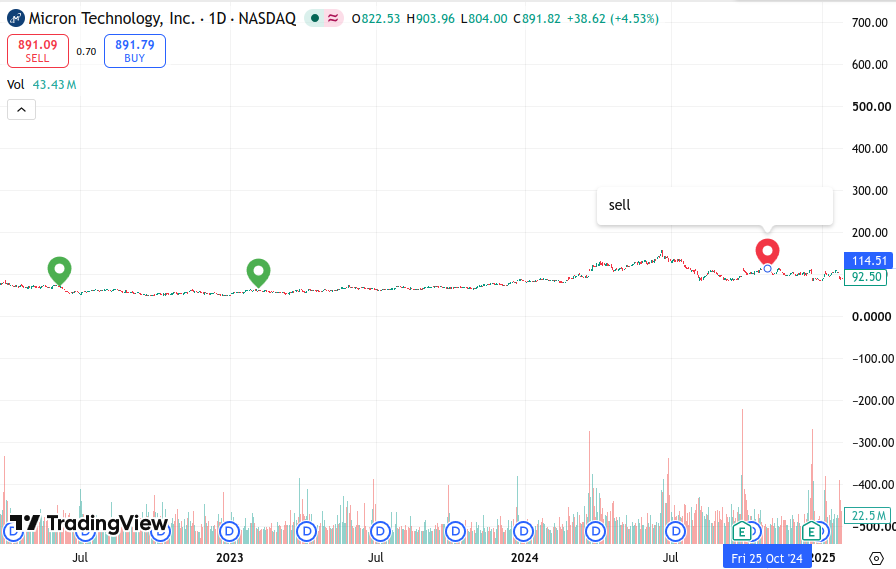
- Buy 1: Jun 10, 2022 at ~$58
- Buy 2: Mar 7, 2023 at ~$58 (added)
- Sell: Oct 25, 2024 at ~$108.5
- Average price: ~$58
- ROI: ~87% over ~2.5 years
- CAGR: ~28% annually
My Entry Point
Micron is a pure play on the memory cycle (DRAM/NAND). In 2022, the sector was in the gutter – falling demand for PCs and smartphones, oversupply, memory prices dropping, sentiment terrible. I knew this wasn’t the end of the world, just a phase of the cycle.
I first entered in June 2022 – a bit early, but that was a conscious decision. The second time was in March 2023, when sentiment was even worse and the price wasn’t significantly different from the first entry. This allowed me to average my risk and improve my starting position.
The thesis: the memory market is cyclical. Booms and busts repeat like clockwork. At the bottom, everyone’s crying; at the top, everyone’s in love. I wanted to buy the tears and sell the love.
How It Played Out
2023 was boring but calm. The sector was gradually recovering from the bottom. The real wave came in 2024 – the semiconductor market came alive, and AI added fuel, boosting interest in memory and infrastructure. Sentiment shifted from negative to strongly positive.
The stock skyrocketed. My assumption about the cycle turning was spot on.
The Exit Decision
I sold in October 2024 because the valuation was no longer attractive. After an ~80–90% gain, further upside became limited, and the risk of a correction was real. Plus, sentiment was already clearly positive, meaning most of the good news was already priced in.
This investment was meant to be purely cyclical – not structural. You buy at the bottom, wait for the rebound, sell on normalization. The scenario was executed – why risk further?
What Went Well
- Calling the cycle – memory has a fairly predictable dynamic.
- Two tranches instead of one – it smoothed out my timing risk.
- Patience – I didn’t panic in March 2023 when the price was near the bottom.
- Playing sentiment – I bought when everyone was trashing the stock.
What Could Have Been Better
- Partial profit-taking instead of a full exit – there’s always room to leave a small piece for the unexpected.
- Larger sizing at the bottom – once I was confident the cycle had turned, I could have been more aggressive.
Takeaways
Semiconductors, especially memory, are the Wild West. DCA at the bottom works if you’re not afraid of short-term pain. The key is not to fall in love with the company – when the cycle ends, you exit, even if it feels like “it could go higher.”
Buy the dip, sell the bounce. Simple, but it takes composure to buy when everyone else is running for the exit.
Update – July 2026
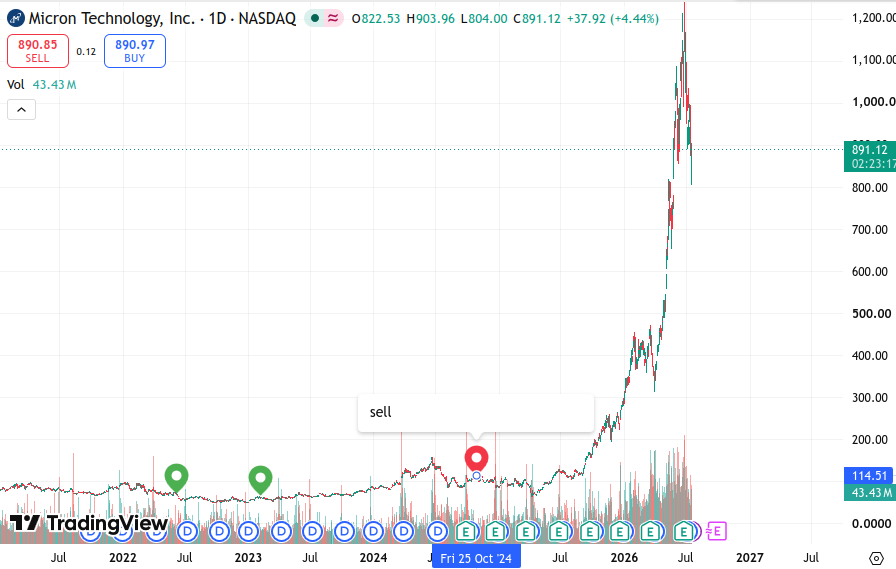
I can’t believe this unassuming company is now leading the current AI boom (or bubble). I never would have thought it could run this hard. I was satisfied with that return back then, but today the position would be up another ~1500%. Absurd, unimaginable.
No point dwelling on it – at the time, I was reducing portfolio risk and decided to cut the position entirely. Revenue growth was disproportionate to the valuation. What’s happening now with this stock is beyond my comprehension. I wouldn’t trust that forward P/E – the hyperscalers will eventually run out of cash…
Below are two charts: the first shows the sexy range where I was buying. The second shows the full spectrum of today’s valuation. Well, we’ll see how this all ends – I suspect it won’t end well for the unaware shareholders who bought above $500.